
Introduction
Artificial Intelligence is transforming customer journey mapping from a static representation of the past into a dynamic system that continuously adapts to customer behavior and intent.
Instead of designing fixed journeys, companies can now orchestrate experiences in real time, using data and predictive insights to anticipate customer needs across every interaction.
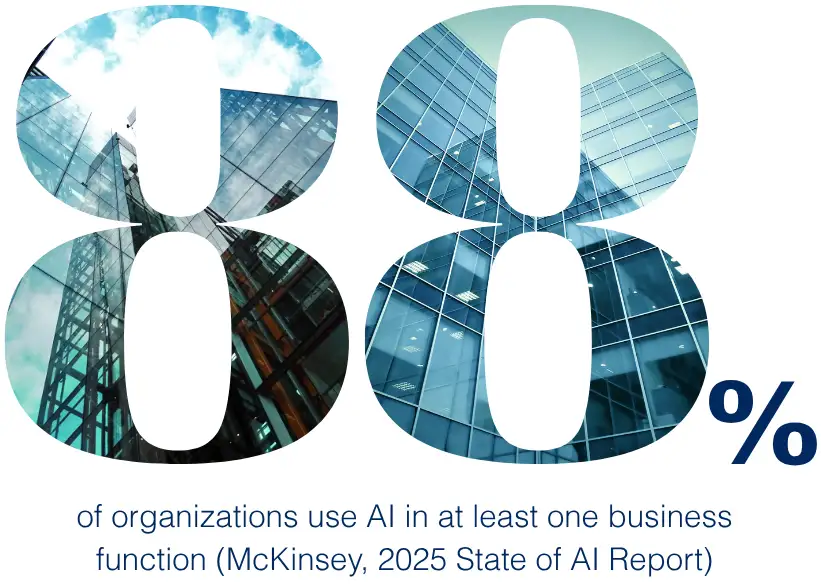
But the real challenge lies elsewhere: the question for companies is no longer whether AI will shape Customer Experience, but how to use it in a way that aligns with customer expectations for trust, transparency and human connection.

The transformation of Customer Experience: From Static Journey Maps to Dynamic Customer Experiences
Customer Experience (CX) mapping has long been a key component of customer-centric strategy. To better understand how customers interact with their brand, companies invest significant time in workshops with internal teams, customer interviews, and the analysis of behavioral data to build hypothetical personas and map customer journeys.
While these approaches provide valuable insights, they are increasingly showing their limits.
At the same time, customer journeys are becoming more complex than ever. Customers move seamlessly across channels, interact with brands in real time, and expect increasingly personalized experiences.
This is where Artificial Intelligence introduces a fundamental shift.
AI is reshaping how companies understand and design customer journeys. By analyzing large volumes of data and continuously learning from customer interactions, AI transforms CX mapping from a static exercise into a dynamic, data-driven process that adapts to customer behavior and expectations in real time.
The Company Perspective: How AI Transforms CX Mapping
Artificial Intelligence is reshaping how companies design and manage Customer Experience. By analyzing large volumes of data and continuously learning from customer interactions, AI enables organizations to understand, predict, and orchestrate customer journeys more effectively.
In practice, AI influences CX design in three major ways.

AI can analyze large amounts of data from multiple sources, such as CRM systems, website behavior, customer service interactions, or social media activity, to reconstruct the actual customer journey.
By identifying patterns across these interactions, companies can better understand how customers truly experience their brand.
Advanced AI models can also analyze emotional signals in conversations or messages to detect signs of frustration, confusion, or satisfaction.
This provides companies with a more accurate and dynamic view of the customer experience.

Beyond understanding past behavior, AI can also predict future actions.
By detecting behavioral patterns, such as churn risk, likelihood to purchase, probability of contacting support, or cross-sell opportunities, AI enables companies to anticipate customer needs and recommend the next best action.
This allows organizations to move from reactive CX to predictive CX.
Instead of responding to problems after they occur, companies can intervene proactively.
For example:
- detecting a customer struggling during onboarding
- automatically triggering guidance, tutorials, or support resources
Predictive insights enable companies to deliver more proactive and personalized experiences throughout the customer lifecycle.

Perhaps the most transformative capability of AI is its ability to orchestrate customer journeys dynamically.
Traditional journey management often relies on predefined workflows such as:
If a customer downloads an ebook → send an email.
This approach follows a linear logic:
Touchpoint → Touchpoint → Touchpoint.
AI introduces a more adaptive model.
This shift enables companies to design experiences around what customers are trying to achieve in real time, rather than simply guiding them through a fixed, predefined funnel.
As a result, customer journeys become more adaptive, evolving continuously throughout the entire lifecycle:
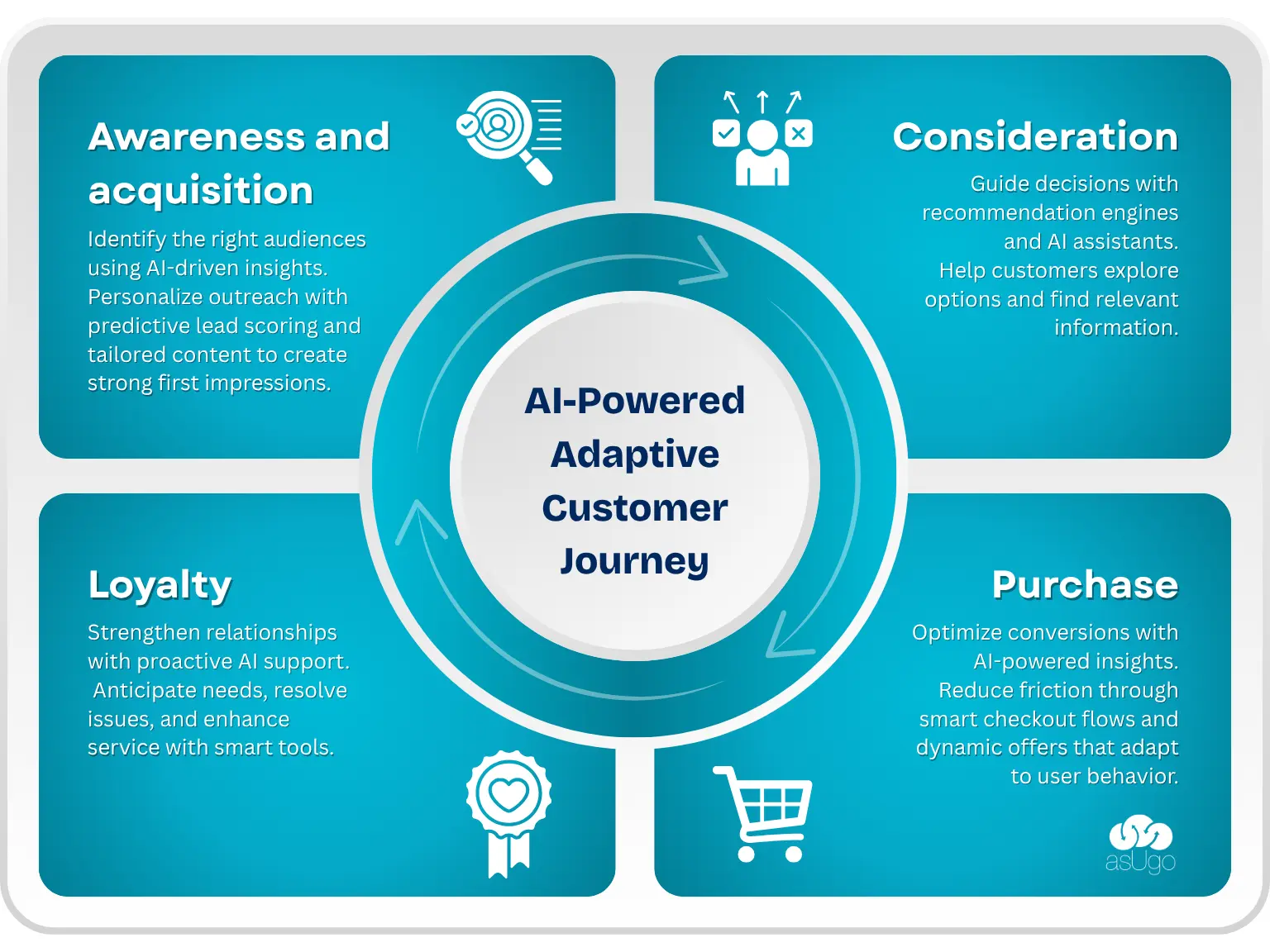
- Awareness and acquisition
AI helps identify the right audiences and personalize marketing efforts through predictive lead scoring and tailored content recommendations. This allows companies to create more relevant and individualized experiences from the very first interaction. - Consideration
During the decision-making phase, AI supports customers with recommendation engines and conversational assistants. These tools make it easier for customers to explore options and access the information they need. - Purchase
AI streamlines the buying process by reducing friction, enabling smarter checkout experiences, and offering dynamic, personalized incentives that improve conversion rates. - Loyalty
After the purchase, AI plays a key role in strengthening customer relationships. It can:-
detect friction and proactively offer assistance
-
anticipate customer needs before issues arise
-
analyze product usage and suggest relevant features or improvements
-
AI also enhances customer service by supporting teams with tools such as:
-
-
chatbots and virtual assistants
-
agent-assist solutions
-
sentiment analysis
-
automated knowledge retrieval
-
Rather than replacing human support, AI improves service quality and consistency, while allowing agents to focus on more complex and high-value interactions.
Finally, AI can detect early signs of disengagement and predict churn risk, enabling companies to take action and retain customers before they decide to leave.
While AI offers powerful opportunities to transform customer journeys, the success of these initiatives ultimately depends on how customers perceive and embrace these technologies.
The Customer Perspective: What Do Customers Expect from AI?
Customer expectations toward AI are evolving, but they remain nuanced.
On the one hand, customers increasingly expect interactions to be faster, smoother, and simpler. AI-powered services promise shorter response times, 24/7 availability, and more efficient interactions.
On the other hand, customers do not want fully automated relationships. Human interaction remains essential. In fact, customers quickly lose confidence when AI systems fail, whether through inaccurate answers, endless chatbot loops, or the inability to reach a human agent.
For AI to truly enhance Customer Experience, it must therefore be reliable, transparent, and trustworthy.
To meet these expectations, companies need to strike the right balance: leveraging AI to improve efficiency while preserving the human touch that builds trust and empathy.
In practice, this means recognizing that AI and humans play complementary roles in the customer experience.
The most effective Customer Experience strategies therefore rely on a hybrid model, where AI enhances operational efficiency while human expertise ensures meaningful and trustworthy interactions.
Conclusion
Artificial Intelligence is redefining how companies design and manage Customer Experience. By transforming static journey maps into adaptive, data-driven systems, AI enables organizations to better understand customer behavior, anticipate needs, and orchestrate interactions across the entire lifecycle.
However, technology alone does not create great experiences. Customers expect AI to simplify interactions while preserving trust, transparency, and meaningful human connections.
The real challenge for organizations is therefore not simply adopting AI, but designing Customer Experiences where AI enhances efficiency while humans continue to deliver empathy, judgment, and authenticity.
The future of Customer Experience will not be AI versus humans, but AI and humans working together to create smarter and more meaningful relationships with customers.
Feel free to reach out to the asUgo team to exchange perspectives or explore how AI can help you design scalable, dynamic customer experiences.
Author: Marie-Noëlle Moinet, Manager, asUgo