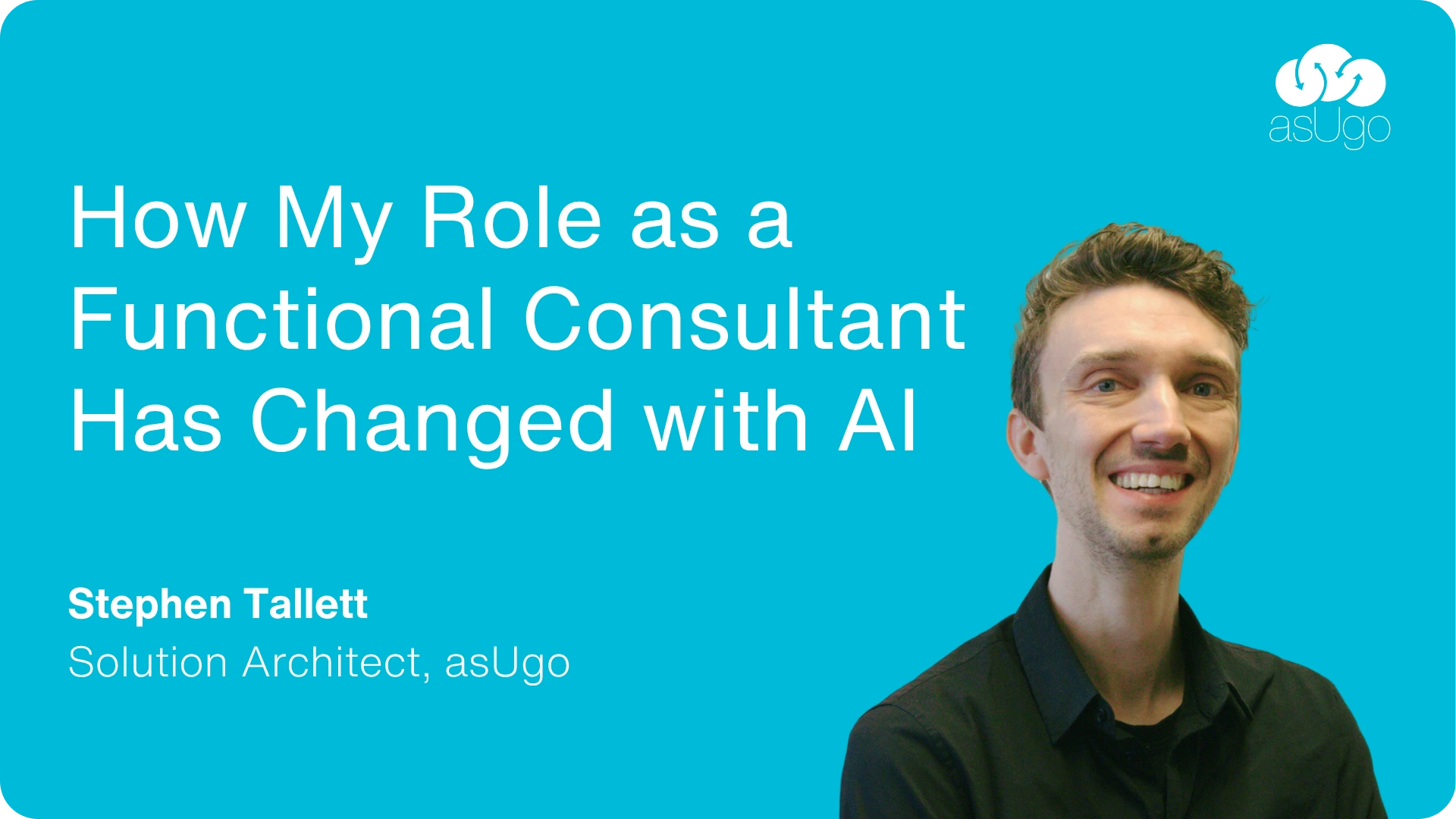
Soon I will reach my 10-year anniversary as a functional CRM consultant. Some would perhaps see this as a milestone in itself, but the real milestone is the way my role as functional consultant has started to drastically change during the last 12 months compared to the years before that. Enough so that it has even motivated me to write some of them down…
What I Have Always Loved About Consulting
Let’s start with things I have always enjoyed about my job, and still continue to enjoy:
- Listening to client’s stories, asking questions and digging deeper into the actual roots of their perceived needs.
- Translating requirements into technical requirements and drawing out business processes and flows
- Working together with a team of multi-skilled colleagues to get the job done and the camaraderie that accompanies it
- Puzzling a system together, feeling like I’ve been given a set of Lego without the instructions, yet knowing what every brick’s capability is, what its purpose could be in this case and how I can make it fit best into the final solution
- Watching “my” system grow with an unnervingly similar feeling I see my children grow
- The agile way of working – a close, co-production of development team and organisational project team, meeting regularly to discuss progress, maintain the focus and tempo and to validate the build direction, ensuring that decisions which could have an impact on the remaining work (however big or small) are made early enough, minimising the risk of surprises, rework or delays.
Above all, building the professional relationship and trust with the people from the organisations I work closely with, to the point where I have the feeling that I am working with colleagues for other organisations rather than clients, gives me the most satisfaction. An environment where both sides are at ease to express themselves openly, clearly, honestly and even (when necessary) bluntly, without the fear of treading on someone’s toes. And for me, the ultimate sign of success and recognition: organisations who willingly come back for more once the initial work is done.
What AI Has Changed in My Day-to-Day Work
After the introduction of AI, the people and relationships aspect of my role have (luckily) not changed. One could argue whether AI could ever replace human interactions, but it’s not my aim to open that one now. Rather it is the technical, day-to-day activities which have been thrust into a major gear change. Tasks where previously the feeling of only the person who had built the solution could posit an insight can now be picked up by just about anyone with the right theoretical knowledge.
AI helps enormously with the analysis while identifying the cause of errors and bugs, including all the hidden dependencies, compared to the traditional replication, trial and error method which consumed both end users’ and developers’ time. It can explain in great detail what a specific flow or automation does or what the impact of a seemingly trivial field data value change has on the rest of the system in ways that the old written documentation (if there even is any!) could only dream of doing before, not even daring to mention whether it was kept up to date or not.
From Hands-On Building to Supervision and Quality Control
All this has resulted in a noticeable evolution of my role even short term:
- From an operational responsibility to a more supervisory perspective – I feel now increasingly like I am supervising a faceless, junior colleague, validating almost every decision they want to make, as opposed to getting my hands dirty doing both the basic, repetitive jobs (object and page layout config anyone?) as well as the more complex flows and automation side of things
- Translating requirements into a prompt which the AI application can use to build or update the metadata – it seems that the transition is towards working from a more quality control, architectural focus as opposed to doing the hands-on build as it was previously.
- The scope of build work I now have control over – as a fully functionally focussed consultant coming from a very non-IT background, I have always been extremely grateful for having colleagues who can handle the more technical side of the build, but since the introduction of AI I have become dangerously close to feeling like a developer. Where previously I would rely on my knowledge of flows, AI now creates and updates apex classes, etc, things I even now wouldn’t dream of trying to decipher myself.
- Reading, reading and more reading – checking and validating the analyses and proposals AI makes, the same way a functional/technical design is signed off. One thing I quickly discovered was to never blindly accept what AI tells you nor the actions it proposes without performing a sense check first. People may be surprised how many times I have had to correct an assertion AI has made or ask it to propose another solution, giving it the concrete direction I want it to take instead of giving it free reign to design what it wants.
The Skills That Still Matter
Knowledge, experience and a simultaneously critical yet open mind are (in my opinion) still invaluable characteristics for a good consultant. Nothing changes there. What is changing, is how the consultant uses and applies them to their daily work. Some of the changes I have noticed may be to be expected as a career progresses over time, even before AI, but that such a transition is happening while remaining in what is essentially the same role in the organisation, and the speed with which it is happening, is what strikes me right now. Change is unavoidable, and, while I do see and experience the benefits first-hand, it is the adoption of the change that determines its success.
Looking Ahead: Enjoying Myself and Learning
I always hated being asked, “where do you see yourself in X years’ time?” Now more than ever, I believe that question remains impossible to answer. My answer, however, remains the same as it did 16 years ago when I started working. Enjoying myself and learning.
And can you be sure this article was actually written by me and not by AI? You’ll just have to trust me on that one.😉
Ready to explore how AI can transform the way you work?
At asUgo, we believe AI is not about replacing people, but empowering them to work smarter, make better decisions and focus on what truly matters.
Whether you’re looking to optimise your Salesforce environment, streamline processes or explore new opportunities with AI, our team is here to help.
Author: Stephen Tallett, Solution Architect, asUgo