Introduction
Dreamforce 2026 marked another important step in the evolution of enterprise AI. While previous editions focused on demonstrating the potential of the Agentic Enterprise, this year the conversation shifted towards making AI agents part of everyday business operations – with better context, stronger governance and measurable results.
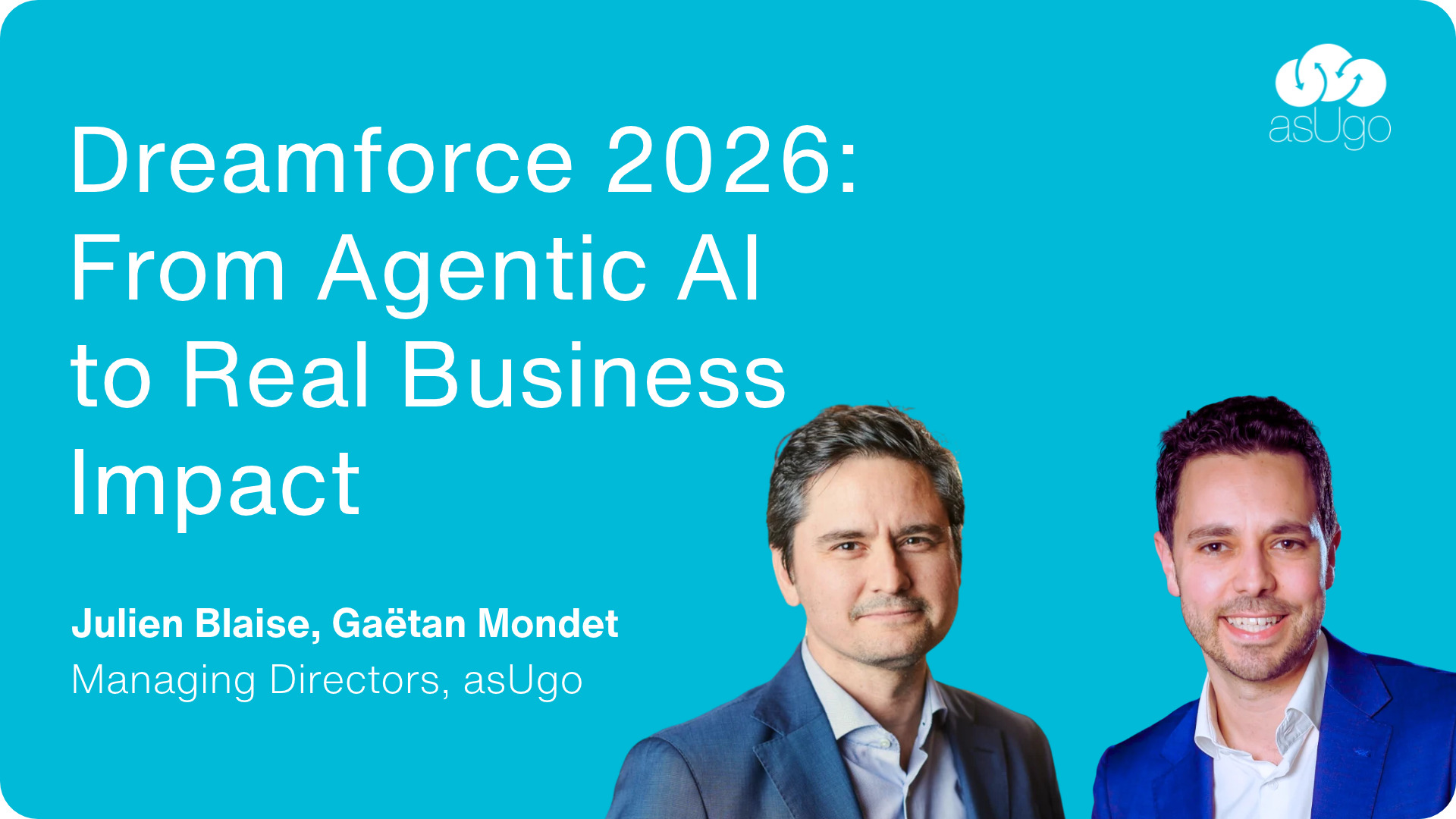
Our Managing Directors, Julien Blaise and Gaëtan Mondet, represented asUgo at Dreamforce, joining the global Salesforce community to explore the latest innovations and discuss what they mean for businesses across Europe.
Back at asUgo, they shared their observations with the team. Beyond the impressive demonstrations and announcements, one message stood out: the future isn’t about deploying more AI agents. It’s about connecting people, data and processes to create real business value.
Here are the developments that caught our attention.
Salesforce Is Becoming More Than a CRM Interface
One of the most significant shifts presented at Dreamforce is the evolution of Salesforce from a traditional CRM interface towards a trusted foundation for enterprise data, business processes and AI.
With integrations involving Claude and Microsoft Teams, employees can increasingly interact with Salesforce without opening its familiar interface.
Imagine a salesperson updating an opportunity directly from a Teams conversation or asking an AI assistant to retrieve customer information, identify priority accounts and trigger the next action.
For organisations, this could fundamentally change how employees interact with their CRM.
The focus is shifting from building screens to building business capabilities that can be accessed wherever people work.
For asUgo, this opens new opportunities to simplify processes, improve user adoption and create more connected employee and customer experiences.
Agentforce: From AI Experiments to AI Colleagues
Agentforce continues to evolve beyond individual AI assistants towards specialised agents capable of supporting complete business processes.
At Dreamforce, Salesforce showcased developments such as Agentforce Coworker, alongside specialised sales agents including Piper and Hunter.
These capabilities illustrate how AI can support lead nurturing, sales development, customer service and recurring operational activities.
But the most interesting development isn’t necessarily the individual agents. It’s how they can work together, access business information and execute tasks across different systems.
The evolution of Agentforce Skills, Agent Script and Observability also brings greater reusability, control and visibility into how agents operate.
At asUgo, we see this as an important step towards making AI a practical part of everyday operations rather than a collection of disconnected experiments.
Get Your Data AI-Ready
One of the clearest messages Julien and Gaëtan brought back from Dreamforce was the importance of preparing data for AI.
Even the most advanced AI agent cannot deliver reliable results without the right business context and trusted information.
For many organisations, data remains fragmented across CRM, ERP, marketing and other enterprise systems.
Solutions such as Salesforce Data 360 and MuleSoft can help connect these environments and make relevant information accessible to AI-powered processes.
However, getting AI-ready doesn’t necessarily mean transforming every dataset at once.
The pragmatic approach is to start with the business process: identify which information matters, assess its quality and address the most important gaps.
For our clients, this means focusing data investments on the areas where AI can create the greatest impact.
Build Skills, Not Just Screens
As Salesforce becomes increasingly accessible through different applications and AI interfaces, the way organisations design and implement solutions is also changing.
Traditionally, CRM projects have focused heavily on configuration, workflows and user interfaces.
With AI, organisations can increasingly develop reusable business capabilities that support both employees and intelligent agents.
This also creates new opportunities for consultants, developers and business analysts.
Instead of simply configuring applications, teams can focus more on designing processes, defining agent behaviour and combining human expertise with AI capabilities.
At asUgo, we already see how this evolution is influencing the way we approach innovation and delivery.
The objective remains the same: creating solutions that solve real business problems. The tools and possibilities are becoming more powerful.
Trust, Security and Governance Take Centre Stage
As AI agents gain more autonomy, organisations need greater control over how they access information and execute actions.
Dreamforce highlighted additional developments in agent monitoring, permissions, security and orchestration, including capabilities around MuleSoft Agent Fabric.
For businesses, this raises important questions: What information can an agent access? Which actions can it perform? When is human validation required? And how can its performance be monitored?
These questions are particularly relevant for European organisations, where data protection, regulatory requirements and digital sovereignty remain important considerations.
AI governance is no longer something to add after implementation. It needs to be designed into the solution from the beginning.
At asUgo, we believe trusted data, strong integrations and clear governance are essential foundations for scaling AI responsibly.
A Growing AI Ecosystem: Salesforce, Claude and Beyond
Another interesting development around Dreamforce was the strengthening collaboration between Salesforce and Anthropic.
For asUgo, this coincides with an important milestone: our confirmation as an official Anthropic partner.
This creates additional opportunities to develop expertise around Claude and explore how AI capabilities can support Salesforce and broader enterprise processes.
However, our approach remains technology-agnostic.
We believe organisations should be able to select the models, platforms and integrations that best fit their business needs, security requirements and existing technology landscape.
The future of enterprise AI is unlikely to depend on a single model or interface. Interoperability, flexibility and the ability to connect different technologies will be increasingly important.
From AI Investment to Measurable ROI
Perhaps the most important takeaway from Dreamforce 2026 is the growing focus on measurable business outcomes.
Deploying an AI agent is not a measure of success.
What matters is whether that agent helps employees save time, reduces operational inefficiencies, improves customer experiences or creates new business opportunities.
As AI becomes more deeply integrated into enterprise operations, organisations must also consider new cost structures, including consumption-based pricing, token usage and ongoing monitoring.
The challenge is moving from demonstrating what AI can do to proving the value it delivers.
For asUgo, this means connecting every AI initiative to a clear business objective, defining relevant KPIs and continuously evaluating its impact.
What’s Next? Four Priorities for Organisations
Four priorities stand out for organisations preparing for the next phase of enterprise AI:
- Get your data AI-ready. Focus on the information and integrations needed to support your most valuable business processes.
- Design permissions and governance. Establish clear rules for data access, agent autonomy, monitoring and human oversight.
- Build skills, not just screens. Develop reusable capabilities that can support people and AI agents across applications.
- Measure business value. Track productivity, efficiency, adoption and AI consumption to understand the real return on investment.
These priorities provide a practical starting point for moving from AI experimentation towards sustainable business transformation.
From Dreamforce to Real Business Impact
Dreamforce 2026 offered an exciting glimpse into the next chapter of Salesforce and enterprise AI.
For Julien and Gaëtan, it was also an opportunity to exchange ideas with the international Salesforce ecosystem and bring new perspectives back to our European team and clients.
At asUgo, we’re already exploring how these developments can support our projects and help organisations make better use of their technology investments.
Because the future of enterprise AI isn’t simply about having more intelligent agents. It’s about making people, processes, data and technology work better together.
Author: Julien Blaise & Gaëtan Mondet, Managing Directors, asUgo