Introduction
Does anyone really know what our customers experience and think? Customers don’t care how you are organized internally… but in the end, it matters a great deal and is actually quite strategic. Customer success rarely fails because people aren’t trying hard enough. It fails because the organization makes it unnecessarily difficult to deliver a consistent experience – across channels (according to PwC’s 2025 Customer Experience Survey: 52% of consumers stop buying from a brand after a bad experience, and 29% leave specifically because of poor customer experience), teams, and the moments that matter most. Customer experience is the pudding your organization serves every day; customers judge you when they actually eat it, not by the recipe.

Most companies recognize the symptoms: customers repeating themselves, inconsistent answers, “handoff fatigue,” long delivery lead times, and an operational model that optimizes internal activity instead of customer outcomes. It’s not a motivational problem. It’s a design problem.
That single idea is, in our view, the most reliable starting point for structuring a customer organization.
This article proposes a pragmatic way to set up (or evolve) your customer organization so customer success becomes scalable: clearer accountabilities, stronger cross-functional collaboration, better use of data, and a measurable improvement loop.
Start from the customer, end with the customer
There are different ways to structure your oragnisation, and there isn’t a standard single version of the truth in this, as company culture and market positioning also matter. Based on our work within Energy, Banking, Telco, Social Profit and Retail, different models can work (agile based, platform, teal, digital first, holocracy, collaborative …).
But often the same principle applies in the most successful ones:
A customer organization should be built around a simple operating truth: customers live an end-to-end journey, not a sequence of departments. Most of us agree with the idea, but does it show in reality?
When organizations are designed around internal functions alone, customers feel and live the wrinkles and joints between them. When organizations are designed around end-to-end journeys, customers feel continuity, even when multiple teams are involved behind the scenes.
That’s why a customer-centric organization typically makes three deliberate choices:
First, it treats customer experience as a starting foundation, not as something you “get” after the product, the process, and the systems are already locked.
Second, it builds an internal rhythm that connects strategy to execution and execution back to learning, so the organization improves as a system, not as individual teams doing local optimizations.
Third, within the structure, it allows for curiosity and innovation through collaborative teams and co-creation with partners, colleagues and customers.
Ok, but is this it?
Customer experience must have “launch power,” not just “opinion power”
Many organizations say customer experience is important and then it somehow dies a bit along the execution process. That creates a familiar pattern: a great experience is described in slides sometimes brought by (external) advisors, but delivery decisions are made elsewhere, and the customer experience becomes the result of compromises down the road (operations, technology, people). That’s why, certainly in a rapidly evolving AI & Robotics-driven world, we strongly believe in an Advisory “métier” that is actually fed by real industry experience and field knowledge. Combining advice with actual technology and human solutions at the beginning, working with clients based on their vision, internal company culture and feedback. So it becomes all about nuance in launching execution.
Hence, a more effective approach is to position customer experience at the same level as portfolio and product decisions. Customer experience should be considered at the same level as the portfolio when launching a product or service. I have personally failed at this when launching a couple of new B2C products and services when working at an energy company: you sometimes tend to push your product and tweak it for customer experience further down the road, instead of using it as one of the decision criteria at the start.
In practice, this means introducing a “customer stamp” logic at the core: customer experience requirements are explicit, measurable, and part of the go/no-go decision, not a late-stage review. What would the customer say? What would our contact center advisor do? What would the technical partner do in this or that situation? Will the sales rep want to sell this? Ask them, stay critical in your thinking, be curious… don’t guess!
This is not about slowing down. It’s about often preventing expensive rework, reducing customer effort, and protecting brand trust. The fastest organizations in the long run are the ones that avoid shipping avoidable friction.
Digital-first is not digital-only
A common trap is to equate “digital-first” with “move everything online.” Customers don’t behave that way. Even in mature digital markets, many customers combine digital and physical touchpoints, often switching channels mid-journey.
A modern customer organization therefore designs for omnichannel by default: one coherent journey logic across touchpoints, with each channel playing to its strengths. This is often backed by good real-time segmentation of the customer portfolio.
Digital-first means “digital by design” while keeping omnichannel as the strategy.
The goal is not to force channel behavior. The goal is to remove channel friction.
This is where a 360° customer view becomes non-negotiable. Without shared customer context, omnichannel becomes a slogan, and customer experience turns into a patchwork of disconnected interactions.
The SCAN operating model: turning customer centricity into execution
To scale customer success, you need more than principles; you need an operating model that makes the organization run the same way, repeatedly, across domains.
A practical structure is the SCAN model: a loop that connects future-oriented thinking, journey design, operational execution, and continuous improvement. It is actually inspired by the PDCA (c) principles.
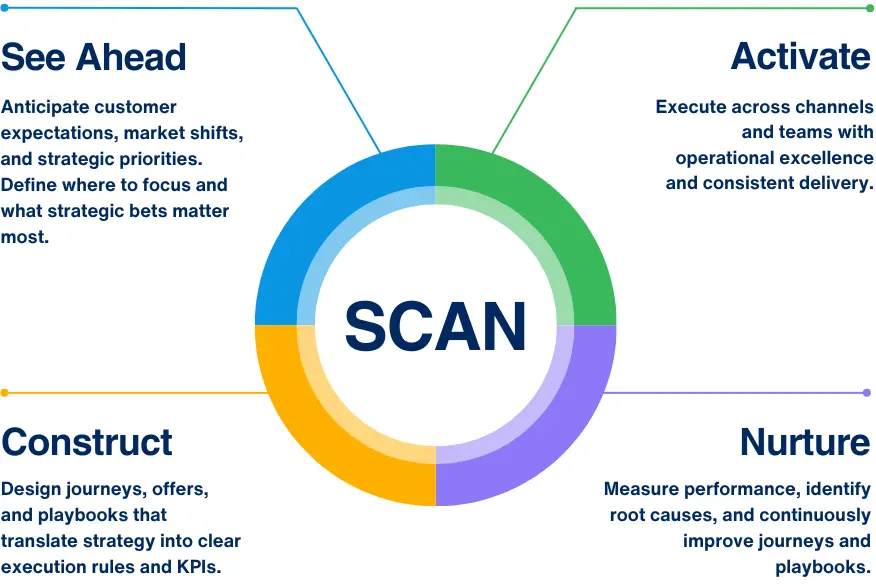
The power of SCAN is the feedback loop. You’re not only executing, but you’re learning. And the learning is structured enough to influence what gets designed next, not just what gets reported.
Organize around capabilities that match the customer lifecycle
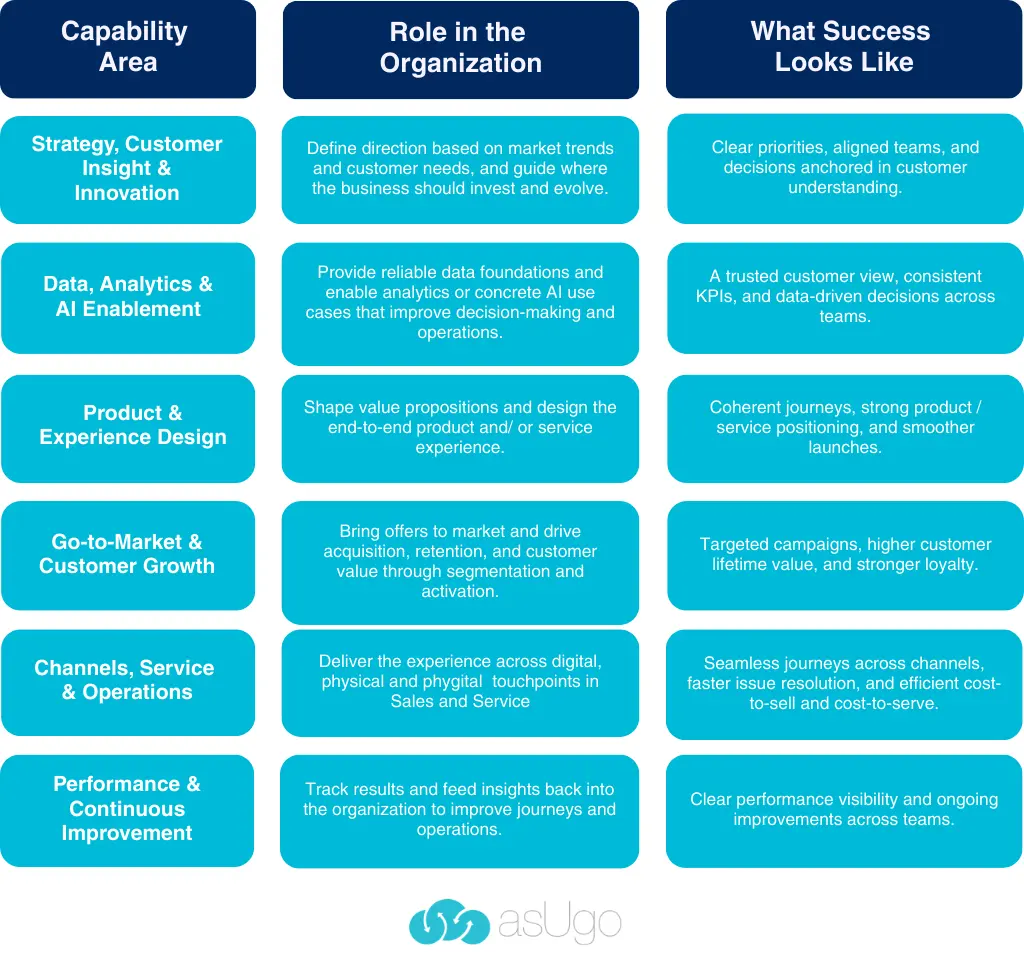
Once the operating model is clear, the next step is designing the organization around a limited number of capability blocks that reflect how customer value is created and pushed end to end. When designing the organization model, nuances and transition over time can be taken into account.A practical blueprint could look like this:
“Playbooks and rules” beat heroic effort
One of the most underrated drivers of customer success is consistency. Consistency is not achieved through good intentions alone; it’s achieved through repeatable playbooks.
A customer organization that scales well typically defines playbooks for:
- key customer journeys (acquisition, onboarding, service, retention, cross- & joint selling, upgrades, multi-territory situation, …),
- channel execution (what must be identical versus what can vary),
- decision rules for prioritization (what gets done when capacity or quality is constrained),
- and customer experience “non-negotiables” from the start (the stamp logic).
This matters even more when you’re integrating teams, brands, different geographies, Business Units or operating models. People can adapt. Systems can scale. But only if the rules of the game are clear enough that execution doesn’t depend on tribal knowledge.
Shift from a reactive model to a proactive model driven by clear playbooks, rules, and an explicit feedback loop.
Customer success improves when decision rights are explicit and when performance discussions translate into concrete changes.
Data & AI: accelerate only when the foundations are real
Customer-centric organizations are increasingly eager to use AI to improve journeys, reduce cost-to-acquire, cost-to-serve and personalize engagement. That ambition is valid, however, the bottom-line value that comes out of it is not always clearly shown (yet).
But the sequencing matters.
If there is no (structured) data, there will be no good AI usage.
Not in any reliable, scalable way.
The priority is building clean, trusted, and shared data foundations that support a 360° customer view, consistent KPI definitions, and cross-channel journey measurement. From there, AI use cases can be prioritized based on the business value they can generate and their implementation feasibility (organisation, business, technical), then tested in controlled pilots before scaling.
A useful mindset here is: start with AI as an enhancer of your playbooks, improving decision-making, routing, knowledge usage, and proactive actions, rather than treating AI as a separate innovation theater.
A pragmatic way to implement in 6-12 weeks
Organization redesign succeeds when it moves fast on clarity and takes sufficient time on the details that require careful change and stakeholder management. We like the adagio “Think big, start small, move fast”… with the most important being: START!
A practical first wave typically focuses on:
The devil is in the detail – and detail only becomes manageable once direction, ownership, and cadence are set.
The bottom line: eat the pudding
Nuance is important, shallowness kills it.
Your brand sets out your promise to the market, customer experience is what you actually deliver to your customers every single day. It is the proof of the pudding that is in the eating. So HOW and WHAT go hand in hand with WHY. Taking that idea from the start through execution and continuous improvement is key.
Customer success is not a department it’s the ultimate output of your operating model and its end-to-end execution.
When you (re)design your organisation through the SCAN logic, you don’t just improve experience. In our opinion, you improve speed, focus and execution quality as a whole.
Transforming a customer organization is rarely about doing everything differently. It is about connecting the dots that already exist internally, boosted by your very own culture.
Feel free to reach out to our team at asUgo to exchange perspectives or explore how customer success can become a scalable operating model in your organization.
Author: Gaëtan Mondet, Managing Director, asUgo